I watched a fascinating bit on CBS 60 Minutes and wanted to share... Definitely check it out. You can see lots of themes that we've covered thus far in class...
Sometimes we have certain emotions and can't quite pinpoint what those emotions are about... I came across this info graphic and thought it was a really interesting way to look at different emotions. Hope you find it helpful...
WHY KIDS DON’T “OUTGROW” REACTIVE ATTACHMENT DISORDER (AND WHAT HAPPENS WHEN THEY GROW UP WITHOUT HELP)
Temper tantrums, the physical need for daily naps, or thumb sucking—these are things that children usually outgrow with time. However, there are certain things that don’t dissipate without plenty of the right help, including the effects of early traumatic experiences. Reactive attachment disorder (RAD) doesn’t just disappear with time, contrary to what some people believe. Children who aren’t effectively treated for RAD most often grow into adults with personality disorders.
Reactive attachment disorder is a brain disorder
Even though other people can’t see the differences on the outside, the brains of children with RAD look different from the brains of children who didn’t experience trauma. Reactive attachment disorder is a brain injury that typically occurs as a result of early abuse and neglect. Just as a person can’t simply “outgrow” the brain disorder of bipolar disorder, neither can a person simply outgrow RAD.
When people experience traumatic events, the stress hormone cortisol gets released in the brain. This biochemical reaction to chronic and extreme stress changes the formation of the brain. Consider this analogy—think of the human brain like the earth and water like trauma. Over time, the release of water over the earth begins to erode the soil into pathways. As pathways form, the water rushes down those pathways again and again until they become canyons. Like the earth, the brain begins to look physically different than it once did. Therefore, the brain reacts differently as a result. When the brain experiences a trauma trigger, fear becomes an overwhelming irrational emotion. The brain automatically goes into survival mode and the person fights, flees, or freezes in his own way. Such triggers only make the erosion and canyons deeper with time. It is not something people can just forget, outgrow, or “get over”.
RAD may look like just another developmental phase, but it’s not
The assumption on behalf of the general public that children with RAD might just be a bit behind developmentally makes sense. They believe that the children will just catch up eventually. Unfortunately, it’s not that simple.
When children who aren’t treated effectively for RAD grow up
When children don’t get the help they need for RAD, their distorted thinking patterns only get more solidified. They often grow up to essentially have “adult RAD”—know as cluster B and C personality disorders. They include borderline, histrionic, antisocial, narcissistic, dependent, or obsessive-compulsive personality disorders. Each disorder is different from the other. Yet, all adults that suffer from these various personality disorders have difficulties with attachment and relationships.
Individuals battling personality disorders aren’t the only ones who suffer. Society as a whole pays the price for untreated trauma as well. According to stress expert and psychiatrist and traumatic stress expert Bessel van der Kolk:
Toxic stress in childhood from abandonment or chronic violence has pervasive effects on the capacity to pay attention, to learn, to see where other people are coming from, and it really creates havoc with the whole social environment. And it leads to criminality, and drug addiction, and chronic illness, and people going to prison, and repetition of the trauma on the next generation. (see reference)
We are all affected by early trauma as a society. It is all of our responsibility.
Ways to overcome early trauma
Childhood provides the best time frame to decrease the lifelong effects of trauma. The older we get, the harder it becomes to battle it. It is possible to battle personality disorders. However, adults must desire to work extremely hard to overcome those beliefs and behaviors that have been ingrained over their lifetimes. The best chances to overcome trauma is to begin the work as soon as possible.
Acknowledge that parents can’t do it alone. Parents need professional assistance to help their children overcome RAD. Furthermore, parents themselves need assistance to recognize their own triggers and anxieties surrounding raising their children with trauma backgrounds.
Understand that, while love is important for children with RAD, love alone will not “fix” trauma.
Even though we can’t see it from the outside, trauma is very real in the everyday lives of those battling it. Unfortunately, to hope it away or wait until adulthood will only exacerbate the problem. It is certainly not an easy road but there is hope. We’ve seen many children get the help they need and grow into adults capable of leading happy lives.
Hi everyone! As the Gender Identity Disorder conversation continues, I came across this and wanted to share... I touch on this topic every semester, and I must say, I am so proud of my students for having mature, respectful conversations about this controversial, complex topic. There are no easy answers.
Trying to put my personal beliefs on the topic aside for a moment, a few things really stuck with me about this clip:
When I saw people emphatically cheering at the school board meeting, it made me very uneasy. I'm not sure 'cheering' is a response we should have on this topic. A kid, who is in a very tough situation, is hurting. A school is divided. It isn't a football game. This is a complex decision with many ramifications. When Gavin got up at the school board meeting: WOW! Most kids shudder at having to do a speech in communications class. This kid spoke up in a room, where clearly there were people who didn't understand/agree with him and were quite vocal about that. No matter where your opinion falls on this issue, I think we can all give him props for doing that. That would have been difficult for me to do, and he was 15-16 years old at the time.
To tie this issue back to another issue we cover is psychology when discussion research is the idea of an operational definition. As one gentleman referred to in the video, what exactly do we base bathroom selection on?
If bathroom selection is to be decided on biological sex, then Gavin would use the women's restroom (biologically, Gavin is a female - even if gender reassignments surgery occurred, the DNA would still show an XY chromosome). To complicate the article even more, there are intersexed individuals - people born with both male and female sexual organs.
We call it a women's restroom, even though woman is a gender term, and remember that is different than biological sex. That, again, confuses the conversation even more. A lot of this confusion is due to the fact that we've always used the words male/man and female/woman interchangeably, when in fact, biological sex and gender are completely separate dynamics.
As a refresher, check out this quick rundown of the difference of gender, sex and sexual orientation: https://youtu.be/xXAoG8vAyzI
Belief perseverance is an interesting phenomenon that we all fall prey to, myself included.
Belief perseverance is the tendency to cling to our initial belief even after receiving new information that contradicts or dis-confirms the basis of that belief.
A few example in my life where belief perseverance has 'clouded' my judgment:
1. I grew up in the 80's. Bagels and pasta were considered a health food because they were low in fat. I used to eat an entire package of Snackwell's cookies and not feel bad because they were fat free (sidenote: they were loaded with chemicals and sugar). I still struggle with the fact that meat and fat are actually good for you, while carbs and low-fat products are bad for you. And, while I know the science, it is still hard to make the mind-shift.
2. I think back to a relationship I had. He WAS a good guy (truth be told, he IS a good guy). He would NEVER cheat on me. Even when I saw evidence that he was unfaithful, I tried so hard to convince myself he wasn't because that isn't who I believed he was. It took a mountain of evidence for me to realize what was happening. My belief that "he would never..." held on tight, despite the mounting evidence.
3. Think back to the last presidential election. The mountain of social media posts, some true and some untrue, aren't swaying anyone's minds. We have our minds made up, and when confronted with conflicting evidence (even if it's true), it's not likely to sway our opinions.
4. Okay, this is a touchy one ~ and I don't mean to offend anyone here, but I think it is a great example of belief perseverance and how strong that force can be. I'm a Christian. I believe in the Bible. I also am a scientist and believe in the scientific process. There are several issues where science and the Bible don't jive and it is very hard for me to reconcile that fact. Where there are discrepancies, the belief I held first typically wins out, even if I am presented with information that contradicts my initial belief.
5. Another touchy subject: The belief that if the government says it's true or good, we accept that it is true. I don't mean to sound like a conspiracy theorist, but I have to admit in my early 20's I was naive to the fact on how our government operated. I believed they made decisions off of research... the more I start to understand politics, I understand this is not at all the case. Politics are extremely murky and often follow a money trail or some political agenda more than hard evidence.
6. Some people hold the erroneous belief that autism is caused vaccinations. There was some bad science that came out in the 90's on this topic. The media and celebrities jumped on the study and were very vocal about the findings, even though the research design was flawed. Once a plethora of new evidence was presented to debunk the finding, some people still cling very closely to this belief.
Our minds are incredibly powerful things ~ and sometimes that is a blessing and sometimes that is a curse.
It's a great debate that is present in any psychology class: Nature vs. Nurture.
Nature being our genes, biological traits that we inherit and have no control over and nurture being our environment (even in utero). Which aspect is strongest when shaping who we are?
I was watching men's beach volleyball during the Olympics and one of the commentators mentioned that if this Brazilian athlete had been born in the United States, he likely would have gone into the NBA, as he had incredible athletic talent and was very tall. Of course, there is no way to tell if that were true, but if definitely got me thinking about the nature/nurture question.
Genetically, this athlete was gifted; He was tall, strong, agile, etc. However, his environment also had a huge impact on him, he was raised in a country where volleyball was a predominate sport, not basketball. He obviously had parents, who encouraged him to play volleyball and nurtured his natural talent. If raised in a different environment, his life may have been very different. If his parents weren't supportive of his athletics he may have just been a tall guy who had lots of potential, but that potential would have never been discovered. If he had lived in a place where basketball was a dominate sport, perhaps he would have played in the NBA and had a completely different lifestyle for himself and his family (I don't know what pro-volleyball players make, but I doubt it compares to what an NBA player makes).
The same can be true for Michael Phelps. Check out this article: https://www.psychologytoday.com/blog/suffer-the-children/201209/adhd-kid-olympic-gold-medalist. Michael was diagnosed with ADHD. He could have easily been a kid who struggle in school, perhaps even one who dropped out because he didn't fit the type of mold that traditional school classrooms are built around. Again, clearly, he has some genetics (nature) that assist him in being a champion swimmer (Have you seen his feet? They are like fins!), He was also in an environment that nurtured that talent: a supportive mom who enrolled him on a swim team and a coach that saw talent, his family had the financial means to pay for swim team and his parents must have worked a schedule that allowed him to participate in practice, he lived in a community that had accessible pools so his craft could be fine tuned. The combination of nature and nurture definitely played a roll in him ending up as the most decorated Olympian of all time.
Check out this article on the ethical treatment of animals in research. It's interesting that there would be an uproar if dogs/cats/primates were kept in similar conditions. Thoughts?
Lab Rats’ Cramped Cages Called Bad For Animals
And Science Too
Research on rats and other animals has been credited with major advances in the treatment of all sorts of deadly ailments, including heart disease, cancer and Alzheimer’s. In fact, it’s been said that “practically every drug, treatment, medical device, diagnostic tool or cure we have today was developed with the help of lab animals.”
But let’s face it: Being a lab rat probably isn’t much fun, and housing may be part of the problem. The typical lab rat spends its days in a cage so small that there’s no room to climb or burrow or even to stand up straight.
And according to the leader of a study of lab rat behavior published June 29 in Royal Society Open Science, being cooped up like that compromises not only the animals’ welfare but also the reliability of rodent research.
“These animals are not ‘normal,’ and therefore may yield ‘abnormal’ results,” study leader Dr. Joanna Makowska of the University of British Columbia told The Huffington Post in an email. “This leads to lack of reproducibility between studies, as well as lack of validity of the results because these results may be idiosyncratic to the specific animals who were used in a particular study, rather than to ‘rats’ in general.”
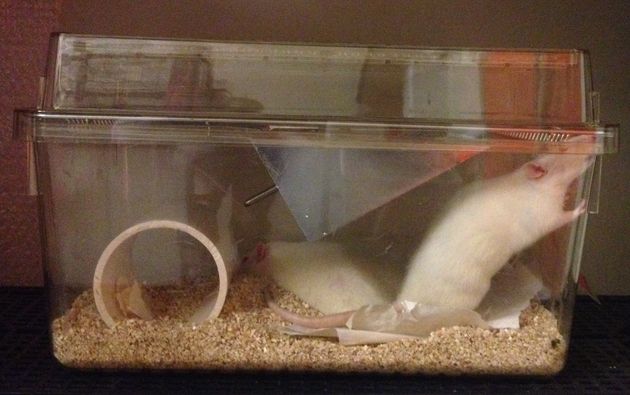
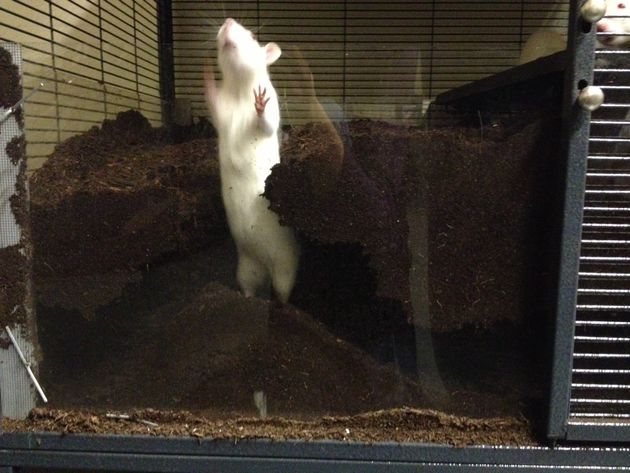
For the study, Makowska and Dr. Dan Weary, an animal welfare expert at the university, observed the behavior of rats housed in standard plastic enclosures, (45 × 24 × 20 cm) and in bigger wire enclosures (91 × 64 × 125 cm) that included soil for burrowing (see below).
JOANNA MAKOWSKA
Standard enclosure for lab rats.
JOANNA MAKOWSKA
Larger, “semi-naturalistic” enclosure.
The rats in the bigger, “semi-naturalistic” cages did a lot of climbing, burrowing and just standing upright. The rats in the standard cages didn’t do those things. But the researchers noticed that those rats stretched out their bodies (a process scientists call pandiculation) nine times more frequently than their big cage counterparts.
As Makowska and Weary wrote in their paper, the extra stretching is likely “a corrective response to the stiffness and positional stress associated with restricted movements in standard cages.”
Sounds unpleasant, for sure. But is there really any solid evidence that rats housed in standard cages are somehow unwell?
This remains an open question, said Dr. Larry Carbone, a lab animal veterinarian at the University of California at San Francisco and the author of the 2004 book What Animals Want: Expertise & Advocacy in Laboratory Animal Welfare.
“Any confinement limits their opportunities, but also, hopefully, limits things they don’t want, like food shortages, extreme weather, lurking predators,” Carbone told HuffPost in an email. “So the challenge is figuring out which of those limitations actually affects the animals’ welfare.”
In any case, cramped quarters may not be the only downside to life as a lab rat.
Recent research suggests that the animals can be stressed by the low temperatures maintained in some labs. And then there are all the things that lab rats experience in the course of experiments, which can include injections, surgical procedures and euthanasia.
In case you’re wondering about legal protections for lab rats, it’s complicated. Some federal regulations do address the treatment of lab animals. But while the all-important Animal Welfare Act protects the well-being of warm-blooded animals in general, it makes an exception for rats, along with birds and mice.
Those exceptions might be a matter of practicality, given the untold millions of rodents and the other unprotected animals housed in U.S. labs.
But Makowska sees another possible reason: People just don’t like rats.
“Rats are less valued than other (larger, cuter) mammals,” she said. “They have been blamed for the plague (which, incidentally, was recently shown to be untrue). They are viewed as pests. And they are constantly being vilified by the world of films, books and cartoons, where they are often made to be the symbol of malevolence.”
Carbone said the study suggests ways in which regulations for housing animals in laboratories should be updated. “Scientists have to make sure that their use of animals really does lead to quality, useful data,” he added, “and they have to do their best to meet current standards of animal welfare.”
As for Makowska, she said rodents should be accorded the same ethical considerations as more charismatic animals. She called for more research — and bigger cages.


 Temper tantrums, the physical need for daily naps, or thumb sucking—these are things that children usually outgrow with time. However, there are certain things that don’t dissipate without plenty of the right help, including the effects of early traumatic experiences. Reactive attachment disorder (RAD) doesn’t just disappear with time, contrary to what some people believe. Children who aren’t effectively treated for RAD most often grow into adults with personality disorders.